

Peugeot car key problems are best checked by separating remote locking, mechanical access and engine starting. Try a known working spare if available, note the exact warning and use the handbook for your model and registration period before changing a battery or reinitialising a remote. Do not disconnect the car battery as a general reset or assume every fault requires a new key.

A worn button, a weak remote battery and an immobiliser warning can feel like the same inconvenience, but they call for different checks. This guide explains seven common symptom patterns, what you can safely observe and when to arrange diagnosis. It covers Peugeot vehicles generally, including how to approach an older 407, without treating one model’s procedure as universal.
Understand Peugeot car key problems before changing parts
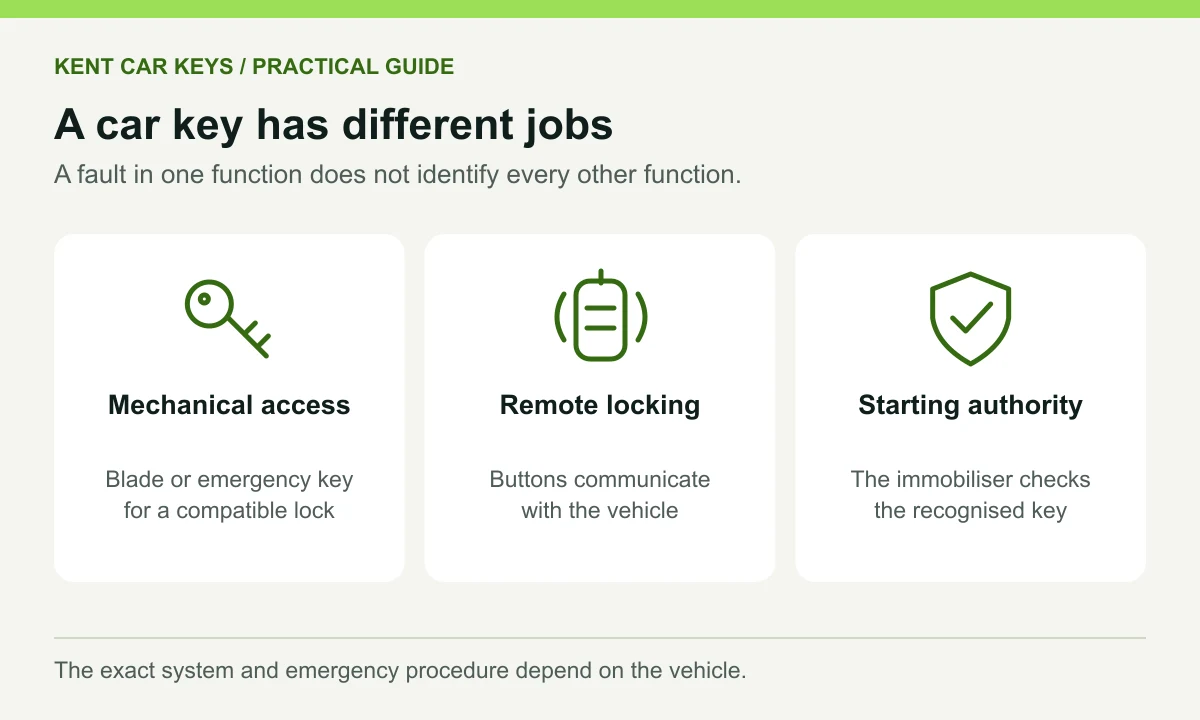
A modern Peugeot key may contain a blade, remote electronics and a transponder used for starting authorisation. A Peugeot keyless fob can also have a concealed emergency blade. Those parts work together, but a Peugeot key fault affecting one function does not prove that everything has failed. For example, a car may start normally while its remote locking buttons do nothing.
Begin by describing the symptom in ordinary language. Does the key turn? Does the remote unlock any door? Does the engine start, crank without starting or show a detection message? Avoid naming a component as faulty before it has been tested. “The unlock button has stopped responding, but the spare starts the car” is more helpful than “the immobiliser needs resetting”.
Keep the vehicle safe while checking. Do not test a failing key in a place where you could become stranded, and do not leave the car unlocked while searching for advice. If somebody is trapped or there is an immediate danger, use the appropriate emergency route rather than waiting for routine key assistance. Roadside safety takes priority over diagnosis.
Symptom 1: the Peugeot remote buttons do not work
If neither lock nor unlock responds, check whether the problem affects one remote or every available key. Test a spare under the same conditions, keeping other keys away so you know which one you are using. Note whether any light on the fob responds, where fitted. A light is an observation, not proof that the vehicle receives a usable signal.
Remote-only Peugeot key problems can involve the battery, button contacts, electronics, synchronisation or a vehicle-side issue. Do not choose between these possibilities from one symptom alone. If the car starts using that key, explain this when booking: it helps distinguish a remote locking concern from a starting-authorisation concern. If it does not start, record that as a separate symptom.
Use the handbook’s mechanical access instructions if you need them. The lock or concealed blade arrangement can vary. Do not force trim covers or push improvised tools into a door. An alarm may behave differently when mechanical access is used, so read the relevant instructions first. If the blade does not turn easily, stop and ask for help.
After any work, check the car is actually locked rather than relying on a button press alone. An indicator flash or sound may be useful, but use the confirmation method appropriate to the vehicle. Keep the working spare available until the affected Peugeot remote has been assessed and the fault has been resolved.
Symptom 2: the Peugeot fob works intermittently
An occasional failure can be harder to describe than a completely dead Peugeot key. Record whether reduced range, repeated presses or one sticking button is involved. Note whether it happens at home, at work or only in one parking location. A repeatable pattern gives a provider useful evidence; it does not, by itself, identify radio interference or a particular Peugeot key fault.
Compare both keys in the same place if that can be done safely during normal use. If one consistently works and the other does not, tell the provider. If both fail together, mention any other electrical symptoms on the car. Do not drive an unreliable vehicle to different places solely to reproduce the fault, and avoid making changes between every test.
Check the outside of the Peugeot key fob for a split case or button that stays depressed. Keep it away from liquid and avoid squeezing or twisting the case to make it work. Pressure can temporarily change an intermittent symptom while creating more damage. Do not insert foil or other material to bridge contacts or hold an unsuitable battery in position.
A short fault record can be enough: which key, which function, where it happened and whether the engine started. If the fault disappears before the appointment, keep the record. An intermittent problem still deserves attention when it affects secure locking or reliable access, even if the key behaves normally during a later attempt.
Symptom 3: a fob battery warning appears
A battery warning is a reason to consult the correct instructions, rather than automatically fitting the cell recommended for a different Peugeot. Find the model, body style and relevant registration period in the official Peugeot handbook directory. Compare the illustration with your actual fob before attempting to open it.
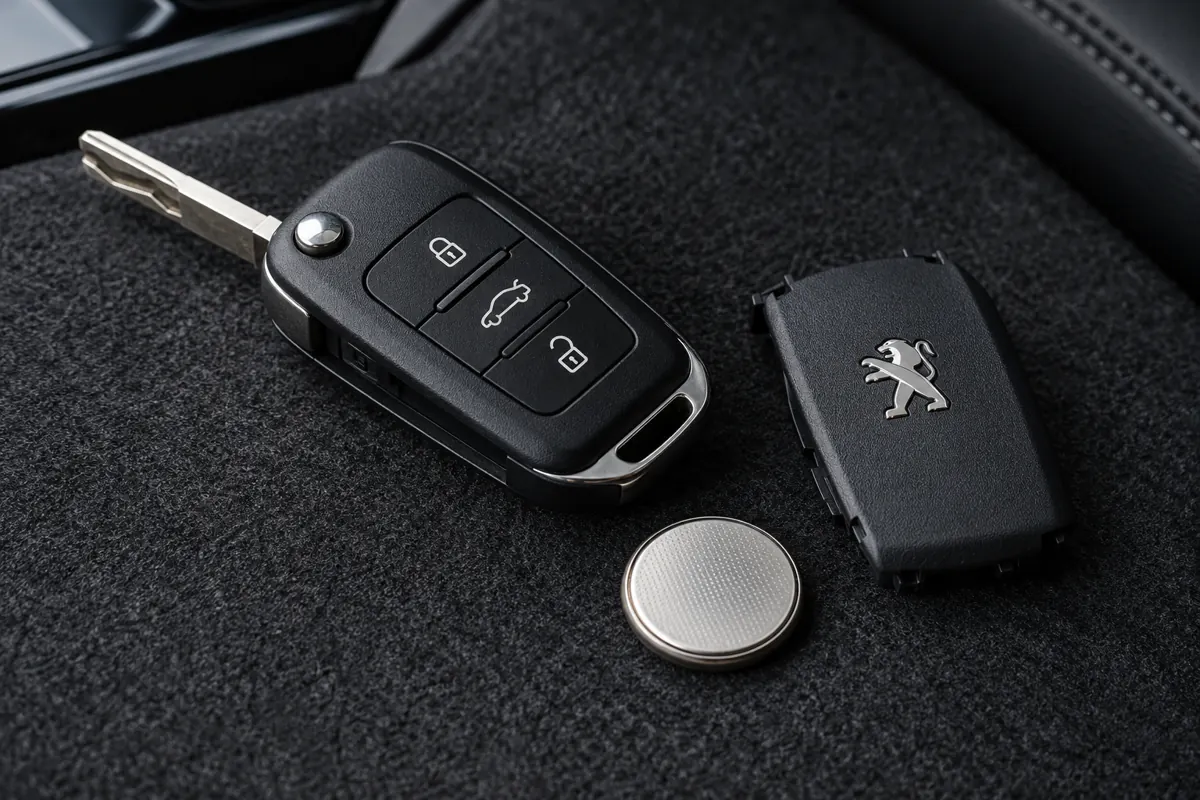
Battery type, polarity and case access can vary between designs. Use the specified replacement and the intended opening point. Work over a clean surface so small parts are not lost, and avoid touching or bending electronic contacts unnecessarily. Stop if the cover resists, a contact moves or the compartment will not close securely. A damaged Peugeot key case needs attention too.
The Peugeot 208 handbook’s access guidance illustrates why battery replacement and remote reinitialisation must be considered separately. It gives different arrangements according to the key system. Use that document only if it matches your vehicle; it is not a general sequence for every Peugeot.
Keep new and used coin cells away from children and animals. Take used batteries to an appropriate collection point. If a fresh, correctly fitted cell does not resolve the symptom, describe the result and seek diagnosis. Repeatedly opening the Peugeot key fob or trying different battery sizes is unlikely to clarify the underlying problem.
Symptom 4: the car says the key is not detected
Write down the exact dashboard wording and when it appears. Does the warning occur before starting, while the engine is already running or after a particular key has been used? Keep the key in the position specified by the handbook. Do not assume that holding it against an area described in a video for another vehicle is the correct back-up method.
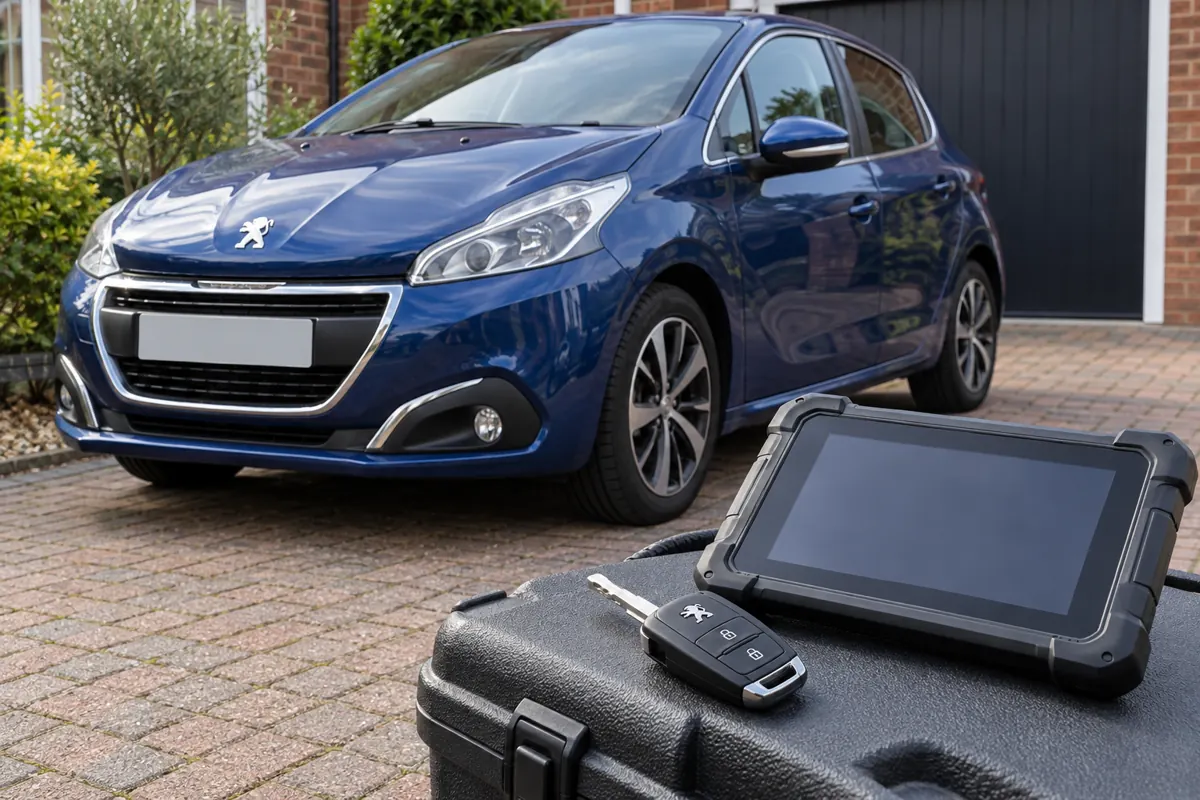
If a known working spare is available, compare it without keeping the affected Peugeot key beside it. A Peugeot spare key that has not been used for a long time may have its own battery or condition issue, so report that uncertainty. Do not treat two unsuccessful attempts as conclusive proof that the car needs a new immobiliser or control unit.
Some Peugeot key problems require vehicle diagnosis as well as key testing. A weak vehicle battery or other electrical fault can complicate the picture. Mention dim lights, unusual dashboard behaviour and any recent work. A remote battery replacement cannot correct every starting fault, and an engine that does not start is not automatically being stopped by the key.
If the warning persists after the relevant handbook checks, contact a Peugeot dealer or a qualified provider who can confirm support for the exact vehicle. Ask whether you should use breakdown assistance rather than continuing to attempt starts. Do not bypass security components, disconnect batteries or remove fuses in an attempt to force recognition.
Symptom 5: the blade, case or buttons are damaged
A cracked shell and failed electronics are different repair decisions. A replacement Peugeot key case may be suitable when reusable internal parts are sound, but the provider must assess that. An empty Peugeot key case is not a complete programmed key. Keep every surviving part, including any small loose component, and explain if somebody has already transferred the electronics into another shell.
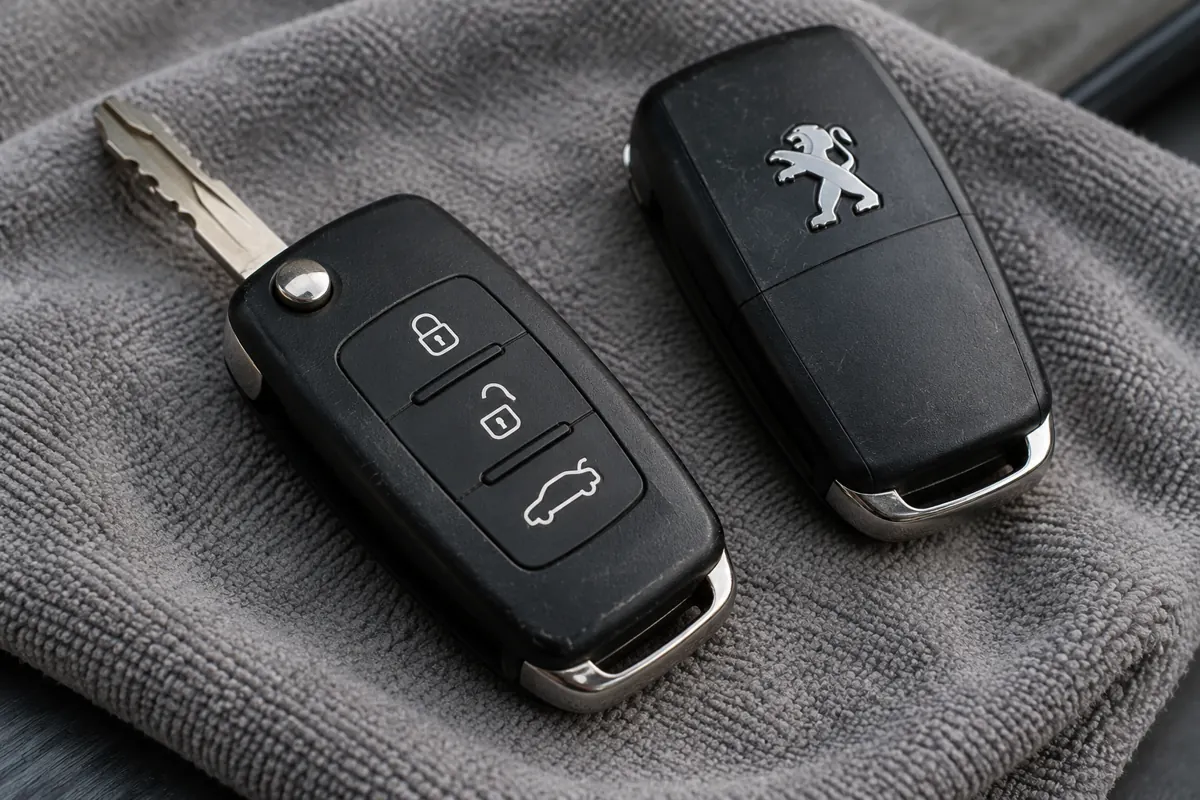
If the Peugeot key blade is bent, worn or loose, do not use pliers or extra leverage to make it turn. A blade that breaks in a lock creates another job. Stop using it if it feels unsafe, use a reliable spare where possible and describe whether resistance occurs in the door, ignition or both. The lock itself may need assessment.
Peugeot key fob buttons can suffer physical wear. Tell the provider if one button fails while the others still respond, or if a button has fallen out. Avoid filling the gap with glue or applying sprays to the electronics. Such attempts can obscure the original fault and make a potentially repairable component harder to assess.
After water exposure, explain what happened and when. Do not use strong heat, a microwave or an oven to dry the key. Ask for appropriate assessment rather than repeatedly pressing it to see whether it still works. If the vehicle must be used, establish whether a separate, reliable key is available and suitable.
Symptom 6: an older Peugeot 407 key has become unreliable
A 407 badge alone does not establish the fault or the correct procedure. Treat the symptoms in the same organised way: separate remote locking, mechanical operation and starting, then compare a known working spare if available. Give the year, key style and any previous repair history when requesting help. Do not assume an online account of another 407 proves the same component has failed.
Case condition can be particularly relevant when an older key has been repaired or rehoused before. Explain whether the buttons, blade or internal parts were transferred. Keep the old case and paperwork if you still have them. A provider can then assess what is present rather than inferring the key’s history from its current appearance.
There is no basis to promise a keyless-entry upgrade as a cure for Peugeot car key problems. A compatible replacement or repair should restore the functions agreed for the actual car. Extra equipment is a separate proposal requiring proper compatibility and security assessment. Ask for the existing fault to be explained before considering unrelated changes.
Likewise, disconnecting the vehicle battery is not a universal 407 remote reset. Use the correct handbook and professional advice for any vehicle electrical work. If a previous reset has already been attempted, tell the provider what was done and what changed afterwards. That history is useful; repeating the same intervention without a diagnosis is not.
Symptom 7: the Peugeot key is missing rather than faulty
A missing Peugeot key changes the enquiry. Say whether every working key is gone, whether the vehicle is locked and where it is parked. An all-keys-lost replacement may involve access, cutting, authorisation and testing; a lockout with the key inside may need a different service. Explain the situation before buying a replacement fob or arranging transport.
Our lost Peugeot car keys in Kent guide covers the first decisions and information to gather. If you are comparing providers, use the Peugeot locksmith and dealership comparison to ask consistent questions. Neither provider’s badge alone confirms availability, compatibility or the complete cost.
Ask about identification and evidence of authority to obtain the key. If the car belongs to an employer, leasing company or another household member, establish what permission is needed. Do not send security codes or identification documents to strangers in public groups. Share necessary details privately through the chosen provider’s appropriate process.
Arrange the right help for Peugeot car key problems
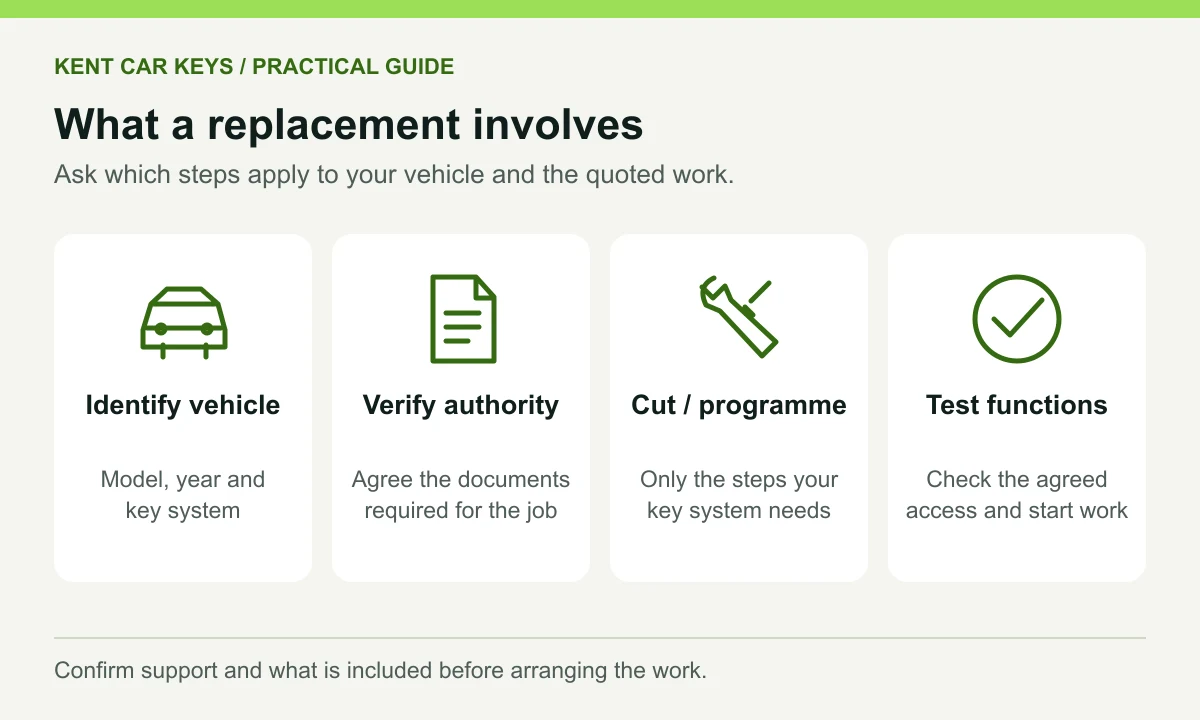
For a present but unreliable key, see our car key repair information. For a replacement enquiry, use the Peugeot key support page. Tell Kent Car Keys the model, year, location, spare-key situation and the checks already completed. Ask for vehicle support, availability and the proposed next step to be confirmed before booking.
Request a quote that explains diagnosis, parts, any programming, attendance and testing. Ask how additional vehicle faults would be handled and authorised if found. Do not assume a new key includes repairs to the locks or car electronics. A clear scope helps you judge whether a repair, replacement or further diagnostic appointment suits the actual symptom.
At handover, test remote locking, mechanical access and starting as applicable, including the retained spare. Keep the invoice and any warranty terms. Follow the handbook and current security advice when storing the keys. The aim is a reliable, supported result for your Peugeot, with an explanation of any remaining fault, rather than a sequence of speculative resets.
Use a simple Peugeot fault comparison
Work through one comparison at a time so the result remains useful. When the first key starts the car and the second does not, keep the first available and arrange assessment of the second. When both start but neither remote locks the car, report a remote-locking symptom. When neither starts and the dashboard is dim or erratic, include those wider observations in the enquiry.
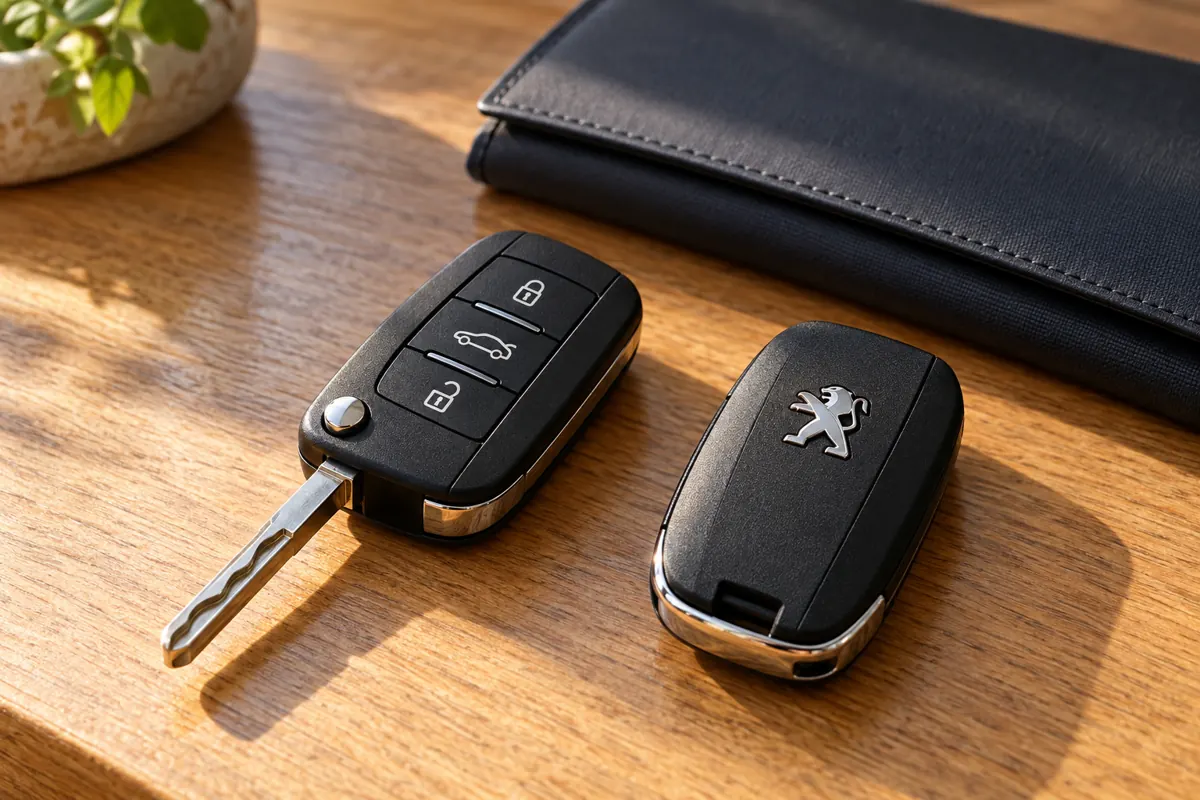
These patterns help describe Peugeot car key problems; they are not a substitute for testing. A provider may need to check both the key and the vehicle before explaining the cause. Do not purchase an immobiliser, receiver or replacement key solely because one line in a troubleshooting chart sounds familiar. Similar symptoms can arise from different faults.
- Only one button fails: describe that button and whether the others respond.
- Only one key fails: identify which key and whether it has been damaged or repaired.
- Both keys fail: describe the vehicle’s other electrical behaviour.
- The blade resists: stop forcing it and mention the affected lock.
- The key is missing: request the appropriate loss or entry service.
Prepare for a Peugeot key appointment
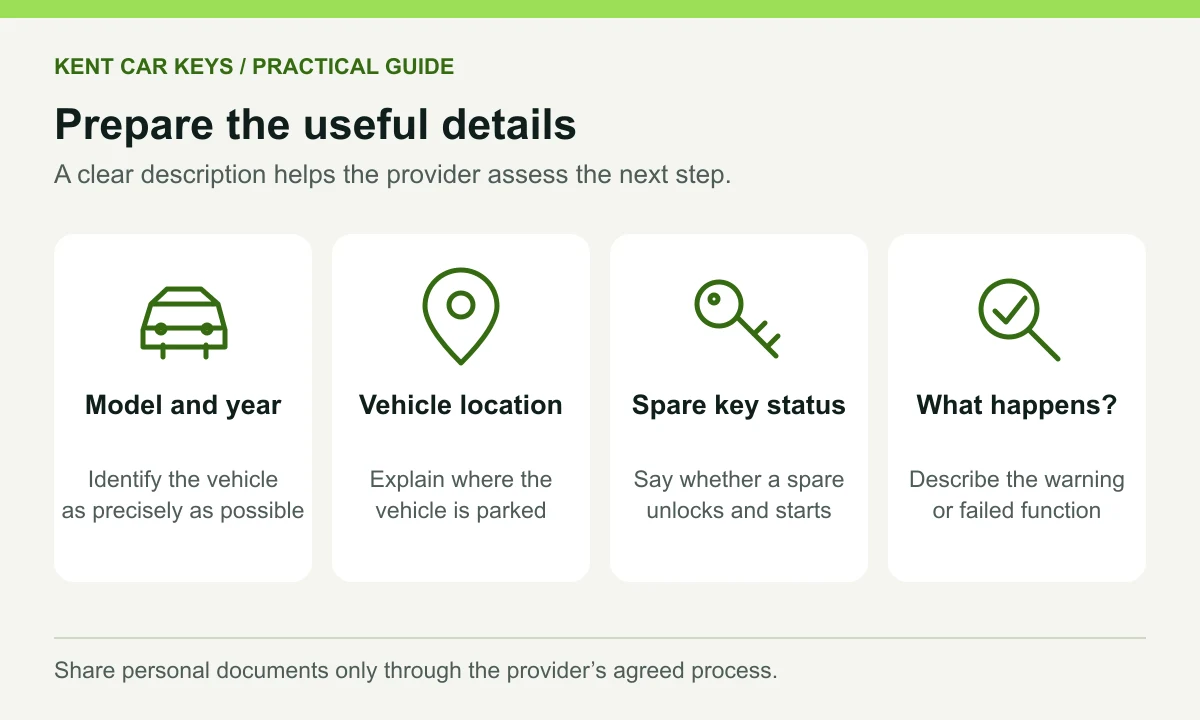
Gather all surviving keys, the registration number and any relevant previous invoice. Tell the provider if the vehicle is in an underground car park, behind a locked gate or somewhere with restricted working space. Confirm who needs to be present and which documents must be shown. Preparing these details can prevent an appointment being unsuitable even when the provider supports the vehicle.
If Peugeot key problems began after a battery change, make a note of the cell type fitted and whether the old one is still available. If they followed a case replacement, explain what was transferred. If they began after vehicle work, describe that work without assuming it caused the fault. Accurate timing is useful evidence; it does not prove responsibility.
Ask whether the initial appointment is for diagnosis, a defined repair or a complete replacement. Confirm what happens if a part has to be ordered or the vehicle needs a workshop. Keep a copy of the agreed scope, including any limits on the quoted work. Do not authorise unrelated additional work merely because the vehicle is already being attended to.
Check the repair under normal use
A single successful button press is reassuring but does not test every agreed function. Before relying on a repaired Peugeot key fob, check the relevant doors, boot function and starting operation with the provider. Try the retained spare separately too. Ask how you should report a repeated intermittent fault and which observations will be useful if it returns.
For the next few ordinary journeys, notice whether the earlier pattern has gone. Keep the invoice and any old parts the provider recommends retaining. If the symptom returns, describe whether it is identical or different, and avoid adding further resets before discussing it. A clear comparison with the original fault helps the next assessment stay focused.